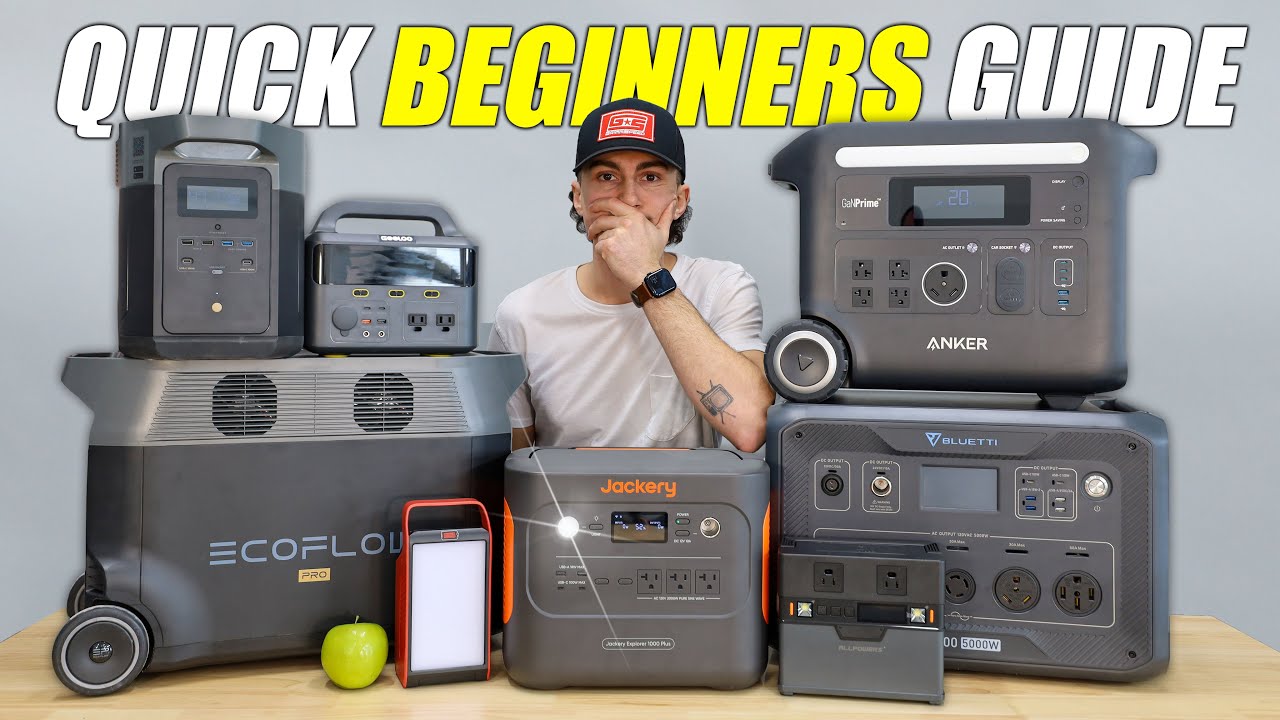
Portable Power Station Buying Guide for Beginners
Welcome to Off-Grid Tech Guide, your go-to source for reliable off-grid solutions in the UK. If you're new to the world of portable power, understanding what a portable power station (PPS) is and how to choose the right one can feel a bit daunting. This guide is designed to cut through the jargon and help you make an informed decision for your off-grid adventures, emergency backup, or mobile power needs.
A portable power station is essentially a large, rechargeable battery pack with an inverter that converts its DC power into usable AC power, similar to your household wall sockets. They also feature various DC outputs like USB-A, USB-C, and 12V car ports. Perfect for camping, van life, garden sheds, or as a crucial backup during power cuts, a PPS offers clean, quiet power without the fumes and noise of traditional petrol generators.
Key Considerations: What to Look For
When selecting your first portable power station, several key specifications will dictate its suitability for your needs. Understanding these will help you compare models effectively.
Capacity (Wh)
Capacity, measured in Watt-hours (Wh), tells you how much energy the power station can store. Think of it like the size of a fuel tank; a higher Wh means it can power devices for longer. For example, a 100 Wh device running for 1 hour consumes 100 Wh of energy.
- Small (250-500 Wh): Ideal for charging phones, laptops, cameras, and running small LED lights for a weekend. The EcoFlow RIVER 2 (256 Wh) or Jackery Explorer 240 v2 (256 Wh) are great compact options.
- Medium (500-1000 Wh): Suitable for longer camping trips, powering a portable fridge, or a few small appliances. Consider the EcoFlow RIVER 2 Max (512 Wh) or Bluetti EB55 (537 Wh).
- Large (1000 Wh+): Best for extended off-grid living, powering demanding tools, or as a robust home backup solution for essential appliances. Look at models like the EcoFlow DELTA 2 (1024 Wh) or Jackery Explorer 1000 v2 (1070 Wh).
Output Power (W)
Output power, measured in Watts (W), indicates how much power the station can deliver at any one time. This is crucial for determining what appliances it can run. Always check the wattage requirements of your devices – the power station's output must exceed this.
Most power stations list both a continuous output (what it can sustain) and a surge output (a brief burst of higher power for starting motors). For instance, an EcoFlow DELTA 2 provides a robust 1800W continuous output, capable of running most household appliances, while smaller units like the Bluetti EB3A offer a respectable 600W for smaller electronics and tools.
Battery Chemistry: LiFePO4 vs. Li-ion
The type of battery chemistry significantly impacts a power station's lifespan and safety. Many modern portable power stations, including most EcoFlow and Jackery models, now use LiFePO4 (Lithium Iron Phosphate) batteries. These offer superior longevity (often 2500-3500+ charge cycles to 80% capacity), enhanced safety, and better performance in varied temperatures compared to older Lithium-ion (NMC) batteries, making them a wise long-term investment.
Charging Options and Speed
How you recharge your power station is just as important as how it discharges. Most units support rapid AC wall charging, car charging, and crucially for off-gridders, solar charging. Look for fast AC charging times, such as the EcoFlow RIVER 2 Pro which charges from 0-100% in about an hour. For solar, check the maximum solar input wattage – higher numbers mean faster recharging from solar panels like the EcoFlow 220W Portable Solar Panel or Jackery SolarSaga 200W.
Portability and Build Quality
Consider the size and weight relative to how you plan to use it. A compact unit like the EcoFlow RIVER 2 (3.5 kg) is perfect for backpacking, while a larger unit such as the EcoFlow DELTA Pro Ultra (6144 Wh) is designed for more stationary home backup or extended off-grid setups. Good build quality, robust handles, and durable casings are essential for frequent outdoor use.
Output Ports
Ensure the power station has the right array of ports for your devices. This typically includes multiple UK AC sockets, USB-A ports, faster USB-C Power Delivery (PD) ports for laptops and modern devices, and 12V DC car ports. The Anker SOLIX C800, for example, offers plenty of versatile outlets for various needs.
Sizing Your Portable Power Station: Practical Examples
To estimate your needs, calculate the total Watt-hours (Wh) for the devices you intend to power. (Device Wattage) x (Hours of Use) = Total Wh needed. Always add a 20-30% buffer for efficiency losses.
For Small Needs (Phones, Laptops, Lights)
If you're primarily charging phones, tablets, a laptop, or running a few LED lights for a weekend camping trip, a smaller capacity unit will suffice. These are also excellent for basic emergency power.
- EcoFlow RIVER 2 (£169): With 256 Wh and 300 W output, it's compact and rapid to charge.
- Jackery Explorer 240 v2 (£169): Offers reliable 256 Wh capacity and 300 W AC output in a super portable design.
- Bluetti EB3A (£169): Provides 268 Wh and a surprising 600 W output in a highly portable package.
For Medium Needs (Camping Fridge, Small Appliances)
For longer trips, running a portable fridge, or powering small kitchen appliances like a blender, you'll need more capacity and output. These are ideal for van conversions or garden office power.
- EcoFlow RIVER 2 Max (£254): Boasts 512 Wh and 500 W output, great for outdoor adventures.
- Jackery Explorer 500 (£254): A lightweight and portable 518 Wh unit with 500 W output, reliable for daily use.
- Anker SOLIX C800 (£424): Provides 768 Wh and 800 W output with plenty of versatile outlets.
For Large Needs (Home Backup, Power Tools, Extended Off-Grid)
If you plan to power essential home appliances during a blackout, run demanding power tools, or sustain extended off-grid living, a high-capacity, high-output power station is necessary.
- EcoFlow DELTA 2 (£509): An excellent choice with 1024 Wh and a robust 1800 W output, ideal for camping and content creation.
- Bluetti AC180 (£552): Offers 1152 Wh capacity and outstanding 1800 W max output performance.
- EcoFlow DELTA 2 Max (£849): An impressive 2048 Wh capacity with 2400 W max output, great for demanding applications.
Integrating with Solar: The Ultimate Off-Grid Setup
To truly embrace off-grid living, pairing your portable power station with solar panels is a game-changer. This allows you to recharge your unit using clean, renewable energy, extending your independence indefinitely.
Look for power stations with high solar input capabilities and consider durable, portable solar panels. For smaller setups, a EcoFlow 110W Portable Solar Panel (£127) or Jackery SolarSaga 100W (£152) can keep your batteries topped up. For larger stations, a Bluetti PV200 (£195) or EcoFlow 220W Portable Solar Panel (£212) will provide much faster charging, optimising your solar harvest even on cloudy UK days.
Conclusion: Making Your Choice
Choosing the right portable power station boils down to understanding your specific power needs, balancing capacity with portability, and considering your budget. By focusing on Wh capacity, W output, battery chemistry, and charging options, you can confidently select a unit that will serve your off-grid ambitions or provide peace of mind during unexpected power outages. Happy adventuring, and stay powered up!